November 12, 2026
Two studies shine a light on eosinophilic esophagitis, an allergic condition that is on the rise
PHOENIX (Nov. 12, 2026) – It can be scary to have a reaction to something you’ve eaten and believe the symptoms indicate a food allergy. But for some, the cause of symptoms may be a different condition that can go unnoticed for years. Two new studies being presented at the American College of Allergy, Asthma and Immunology (ACAAI) Annual Scientific Meeting look at how eosinophilic esophagitis (EoE) diagnoses are on the rise, and how EoE symptoms can be mistaken for a food allergy.
EoE is an allergic condition of the esophagus, the tube that carries food from your mouth to your stomach. In people with EoE, a type of white blood cell called an eosinophil builds up in the esophagus. This causes swelling and irritation. Over time, it can make it hard to swallow and can cause food to get stuck.
The first study looked at 29 adults who had been sent to an allergist because doctors thought they experienced anaphylaxis, a severe allergic reaction, after eating certain foods. On average, each patient had gone to the emergency room three times, and most had been given at least one dose of epinephrine.
Their symptoms included a tight throat, trouble swallowing, chest pain, drooling, and food getting stuck in their esophagus. But testing did not show a true food allergy. Instead, tissue samples taken from their esophagus showed that the patients had EoE. On average, it took more than five years for them to get the right diagnosis.
“Not every frightening reaction after eating is anaphylaxis,” said allergist Talal Nsouli, MD, ACAAI member and lead author of the study. “Eosinophilic esophagitis can closely mimic food allergy and may lead to repeated emergency visits before the correct diagnosis is made. When throat tightness, difficulty swallowing or food impaction recur, especially with negative food allergy testing, we should think about EoE. Early recognition can prevent years of uncertainty and progressive esophageal damage.”
Getting a prompt and accurate diagnosis is important. Additional research shows that when EoE is not treated, scar tissue can build up and narrow the esophagus. The chance of this narrowing increases about 9% for every year the disease goes untreated.
The second study used health records from more than 300 million patients in the U.S., making it the largest study of EoE in the country to date. Researchers found more than 500,000 people with an EoE diagnosis.
Key findings include:
- The number of people diagnosed with EoE has increased by about 7 times since 2009.
- EoE was most often first diagnosed in two age groups: the teen years and people in their 40s.
- Males were more likely to have EoE than females.
- Rates were highest in northern states, with New Hampshire at the top.
- People with several allergic conditions, such as asthma, hay fever, eczema, and food allergies, were much more likely to have EoE. Among food allergies, wheat allergy had the strongest link.
“We are seeing increased EoE over time,” said allergist Bushra Tbakhi, MD, lead study author and ACAAI member. “Associated allergic conditions may help identify patients at high risk for EoE.”
Abstract Title: When Anaphylaxis Is Not Anaphylaxis: Eosinophilic Esophagitis Mimicking Food Allergy
Presenter: Talal Nsouli, MD
Abstract Title: Epidemiology and Clinical Features of Eosinophilic Esophagitis: Analysis Using the COSMOS Database
Presenter: Bushra Tbakhi, MD
For more information on the diagnosis and treatment of EoE, or to find an allergist in your area, visit AllergyandAsthmaRelief.org. The ACAAI Annual Scientific Meeting is Nov. 12-16 in Phoenix. For more news and research from the ACAAI Scientific Meeting, go to our newsroom and follow the conversation on X/Twitter #ACAAI26.
About ACAAI
The American College of Allergy, Asthma & Immunology (ACAAI) is a professional medical organization of more than 6,500 allergists-immunologists and allied health professionals, headquartered in Arlington Heights, Ill. Founded in 1942, the College fosters a culture of collaboration and congeniality in which its members work together and with others toward the common goals of patient care, education, advocacy, and research. ACAAI allergists are board-certified physicians trained to diagnose allergies and asthma, administer immunotherapy, and provide patients with the best treatment outcomes. For more information and to find relief, visit AllergyandAsthmaRelief.org. Join us on Facebook, Instagram, Threads and X.
WHEN ANAPHYLAXIS IS NOT ANAPHYLAXIS: EOSINOPHILIC ESOPHAGITIS MIMICKING FOOD ALLERGY
R033
T. Nsouli*, N. Diliberto, E. Abou-Jaoude, S. Nsouli, J. Bellanti, Washington, DC
Introduction
Eosinophilic esophagitis (EoE) may present with acute food-triggered symptoms that
closely resemble IgE-mediated anaphylaxis. We reviewed patients referred for recurrent
presumed food-induced anaphylaxis who were ultimately diagnosed with EoE.
Methods
A retrospective review was performed of clinical history, allergy evaluation, treatment
response, and endoscopic/histopathologic findings in 29 consecutive patients
subsequently diagnosed with EoE.
Results
The cohort included 20 males (69%) and 9 females (31%), with a mean age of 38.5 ± 9.1
years. Patients reported recurrent episodes following ingestion of common food allergens
and experienced a mean of 3.24 ± 1.30 emergency department visits (median 3, range
1–6) and 0.97 ± 0.84 epinephrine administrations (median 1, range 0–3). The mean time
to diagnosis was 5.55 ± 2.20 years (median 6, range 2–10). Predominant symptoms
included throat tightening, dysphagia, chest pain, hypersalivation, food impaction, and
inability to swallow. Allergy evaluation failed to support IgE-mediated anaphylaxis.
Esophageal biopsies demonstrated ≥15 eosinophils per high-power field in all patients,
confirming EoE. This prolonged diagnostic delay is clinically important, as the risk of
fibrostenotic stricture increases by approximately 9% for each year of untreated disease.
Fibrostenosis is driven by chronic type 2 inflammation, with IL-4, IL-13, and TGF-β1
serving as key profibrotic mediators.
Conclusion
EoE should be considered in patients with recurrent food-associated dysphagia, throat
tightening, or food impaction, particularly when allergy testing is negative or response to
epinephrine is incomplete. Early recognition and prompt endoscopic biopsy are essential
to prevent misdiagnosis, unnecessary treatment for presumed anaphylaxis, and
progressive fibrostenotic esophageal remodeling.
EPIDEMIOLOGY AND CLINICAL FEATURES OF EOSINOPHILIC ESOPHAGITIS: ANALYSIS USING THE COSMOS DATABASE
R304
B. Tbakhi*, R. Lee, M. Rothenberg, S. Andorf, S. Zhang, Cincinnati, OH.
Background
Eosinophilic esophagitis (EoE) is a chronic allergic disease of the esophagus with increasing prevalence. We aimed to characterize EoE epidemiology and clinical features in the largest U.S. cohort to date.
Methods
We retrospectively analyzed the Epic Cosmos database (1990–2024), comprising over 300 million deidentified patients, for prevalence, incidence, geographic distribution, comorbidities, and treatment patterns. EoE was identified by diagnostic code alone (diagnostic code) or in combination with endoscopy and histology (combined criteria).
Results
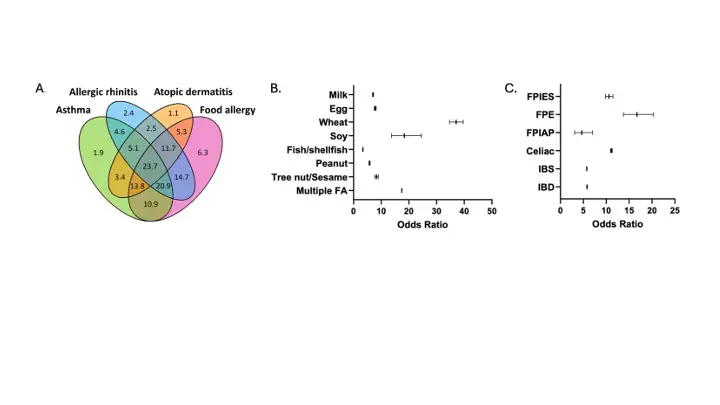
Of 300,278,878 patients, 508,739 had EoE by diagnostic code and 159,279 by combined criteria. Among patients with EoE identified by diagnostic code alone, there was a bimodal distribution of peak incidence in the second followed by the fifth decade of life. There was an overall higher proportion of males to females (59%), but this predominance decreased with increasing age. Since 2009, prevalence and incidence increased by 7.1 fold and 1.3 fold, respectively. Rates were highest in northern states (i.e. New Hampshire 0.31%). EoE is strongly associated with the presence of multiple allergic comorbidities (OR 23.7), food allergy (OR 6.3) and gastrointestinal diseases (i.e. celiac disease; OR 11.1). Amongst specific IgE mediated food allergies, wheat showed the strongest association (OR 37.1). Proton pump inhibitors were the most common treatment (83.4%); however, dupilumab use rose 4.4 fold since FDA approval in 2022, without increased risk of eosinophilia or malignancy.
Conclusion
EoE prevalence is rising in the U.S. with regional variation and strong associations with atopic and gastrointestinal comorbidities. These findings provide updated epidemiologic and clinical insights and highlight evolving treatment trends.
Allergic comorbidities among patients with eosinophilic esophagitis (EoE)
A) Odds ratios (ORs) for the presence of EoE in patients with single or various combinations of atopic comorbidities, including asthma (n = 3,016), allergic rhinitis (n = 67,644), eczema (n = 5,301), and food allergy (n = 20,261).
B) ORs (middle marker) with 95% CI (left and right markers) for the presence of EoE in patients with specific food allergies, including milk (n = 4,946), egg (n = 2,313), wheat (n = 914), soy (n = 48), fish/shellfish (n = 4,306), peanut (n = 3,210), tree nut/sesame (n = 760), and patients with multiple food allergies (FA) (n = 23,424).
C) ORs for the presence of EoE in patients with gastrointestinal and food protein–induced disorders, including food protein–induced enterocolitis syndrome (FPIES) (n = 674), food protein–induced enteropathy (FPE) (n = 105), food protein–induced allergic proctocolitis (FPIAP) (n = 23), inflammatory bowel disease (IBD) (n = 22,782), and irritable bowel syndrome (IBS) (n = 48,230).